SGB Custom Painting Blog
How Often Should I Repaint The Exterior Of My Home?
Peterson SEO • December 19, 2025 | Chico, CA | USA

The Question Every Homeowner Asks
Owning a home in Chico means dealing with a constant cycle of maintenance... from clearing pine needles from the gutters in the fall to keeping the lawn alive during our scorching summers. But one of the biggest, most expensive questions that looms over every homeowner is about the paint. You pull into the driveway after a long day, look at the siding as the late afternoon sun hits it, and wonder... "Can I get another year out of this? Or is it already too late?"
It is a tough call to make. Paint your house too early, and you spend money you didn't need to spend yet. Wait too long, and you risk dry rot, extensive water damage, and a repair bill that could be triple the cost of a simple paint job. The timing isn't just about curb appeal or keeping up with the neighbors. It is about protecting the structural skin of your home from the punishing elements. In our area, where we see blistering UV rays in July and soaking, driving rains in January, that protection is the only thing standing between your siding and decay.
Your home’s exterior paint is the first line of defense against moisture intrusion, pest infestation, and structural failure. When that barrier fails, the costs escalate rapidly. If you are trying to budget for the future or just figuring out if your home is due for a refresh, this comprehensive guide will help you spot the signs before little problems turn into big ones. We will break down timelines by material, the specific signs of failure to look for, and why the unique climate of Butte County changes the rules for maintenance compared to the rest of the country.
Quick Answer: How Often Should I Paint?
In the Chico climate, you can generally expect a quality paint job to last between 3 and 10 years. This wide range depends entirely on your specific siding material and exposure.
- Wood Siding (T1-11, Cedar): The most demanding material, usually needing maintenance every 3 to 7 years to prevent dry rot.
- Stucco: Highly durable and heat-resistant, often lasting 5 to 10 years before hairline cracks need sealing.
- Fiber Cement (Hardie Board): The longevity leader, often holding its finish for 10 to 15 years.
- Aluminum or Vinyl: Typically refreshed every 5 to 10 years primarily to fix fading rather than structural failure.
Crucial Note: Pay special attention to the south and west-facing walls. These sides absorb the most intense UV radiation in the valley. If you spot chalky residue or peeling paint on these specific walls, your timeline is up, even if the shaded north side still looks fine. A proactive exterior painting Chico professional will always tell you: paint before the failure spreads to the wood.
The "Chico Factor": Thermal Shock and UV Radiation
If you lived in a mild, foggy coastal town like Eureka or Monterey, your paint might last significantly longer. But here in the Sacramento Valley, we deal with a phenomenon known as "Thermal Shock." During the summer, your exterior walls can absorb heat and reach surface temperatures well above 140 degrees during the day. As soon as the sun goes down, our dry air causes those temperatures to plummet, sometimes dropping 40 or 50 degrees in a matter of hours.
This rapid heating and cooling causes the materials of your home... wood framing, plywood sheathing, stucco, and concrete... to expand and contract violently.
This constant movement puts immense stress on your paint film. As we explored in our deep dive on the real differences between indoor and outdoor formulas, exterior products are engineered with flexible resins specifically to stretch with your home during these cycles. But over time... even the best resins lose that elasticity. When the paint becomes brittle from years of UV baking, it loses its ability to stretch. Eventually, it snaps. Once it creates microscopic cracks, moisture from our winter rains wicks in behind the coating. That trapped water expands when it gets cold, pushing the paint off the wall and leading to peeling and rot.
Detailed Timelines Based On Your Siding Material
Your home's skin determines its painting schedule. Different materials hold paint differently, and knowing exactly what you have is the first step in planning your budget.
Wood Siding: The Most Vulnerable
Wood is beautiful, organic, and porous. It naturally wants to absorb moisture. In Chico, we see a lot of two specific types of wood siding:
- T1-11 (Plywood Siding): This is very common in homes built in the 70s and 80s. It has vertical grooves and a rough texture. Because it is essentially plywood, the bottom edges act like a sponge. If T1-11 is not kept sealed with paint, the bottom edges will swell, delaminate, and rot very quickly. Timeline: 3-5 years.
- Cedar or Redwood Lap Siding: These materials contain natural oils that help resist rot, but they still need protection. Solid stain or paint helps seal the grain. As noted by San Diego’s industry experts at Ron Rice Painting, regular maintenance checks are vital for wood surfaces because once the paint seal is compromised, moisture damage accelerates rapidly. Timeline: 5-7 years.
- Stained Wood: If you have a semi-transparent stain to show off the grain, be prepared for maintenance. These coatings lack the heavy pigment load that blocks UV rays, so the sun burns them off faster. Timeline: 3-4 years.
Stucco: Durable but Prone to Cracking
Stucco is a rigid masonry product. It is fire-resistant and holds paint very well because of its rough texture. The paint bites into the pores and holds on tight.
- The Risk: Because stucco is rigid, it doesn't flex. When the ground settles or the wood framing underneath moves, stucco develops hairline cracks. If these aren't sealed with a high-build elastomeric paint, water enters the wall cavity and can rot the framing without you ever seeing it from the outside.
- Timeline: A high-quality paint job on stucco can last 7-10 years, but you should inspect for cracks annually.
Fiber Cement Siding: The Low-Maintenance Leader
Brands like James Hardie have revolutionized exterior siding. This material is made of cement, sand, and cellulose fibers. It is dimensionally stable, meaning it doesn't expand and contract wildly like wood does.
- The Benefit: Because the board doesn't move, it doesn't stress the paint. Factory finishes can last 15 years, and even repaints can last a decade or longer because the bond remains undisturbed.
- Timeline: 10-15 years.
Vinyl and Aluminum: Assessing the Fade
Older vinyl or aluminum siding doesn't rot, but it does get ugly. The main issue here is "chalking" and fading. The sun breaks down the plastic or the coating on the metal, leaving it looking powdery and washed out. Painting these materials is a great way to restore curb appeal without the massive cost of re-siding.
- Timeline: 5-10 years for aesthetic purposes.
The 7 Warning Signs It Is Time To Paint
You don't need a calendar to know if your house needs work... you just need to look for these visual clues. We recommend inspecting your home at least once a year, preferably in the spring after the rains have stopped.
1. The Chalk Test
Go to the sunniest side of your house (usually the south or west face) and wipe your open hand firmly across the siding. Do you see a powdery residue on your palm that looks like chalk dust? That residue is the pigment of the paint. The sun has burned away the resin binder, leaving the dust behind. When paint chalks, it is getting thinner by the day. This chalking is widely recognized by manufacturers as the first stage of coating failure. Catching it now prevents the need for heavy sanding later.
2. The Fading Factor
Stand back and compare the north side of your house (shade) to the south side (sun). Is the south side significantly lighter? Fading is not just a cosmetic issue. It indicates that the UV rays are breaking down the chemical bonds in the coating. Dark colors absorb more heat and will fade faster than light colors. Once the color is gone, the protective qualities are usually failing too.
3. Peeling, Flaking, or Bubbling
These are the "red alert" signs. If you see paint lifting away from the surface, moisture has already compromised the bond. Bubbles usually mean water vapor is trapped behind the paint film, trying to escape from the house or the siding. At this stage, you are no longer preventing damage... you are actively managing a failure. Waiting another winter could lead to dry rot in the wood underneath.
4. "Alligatoring"
This looks exactly like it sounds... a pattern of cracks that resembles reptile skin. It happens when an upper layer of paint dries too quickly over a softer layer underneath, or when old oil-based paint naturally ages and loses all flexibility. These cracks might look small, but they are thousands of open doors for water to wick into your siding.
5. Caulk Separation
Take a close look at the seams around your windows, doors, and corner boards. Is the caulk cracked, brittle, or pulling away from the joint? Caulk is the flexible seal that keeps water out of the wall cavity. Even if your paint looks okay, failed caulk can allow water to rot the wood trim from the backside. A good paint job always includes cutting out and replacing failed caulk.
6. Moisture Stains or Mold
If you see dark spots or mildew growing on your paint, it could just be a dirty house... or it could be a sign that the paint's mildewcide additives have worn off. If you pressure wash it and the stains come right back, or if you see stains that look like water runoff, your coating is no longer sealing the surface effectively.
7. Wood Rot (The Soft Test)
Take a screwdriver and gently press on the bottom of your door frames, window sills, and the bottom edge of your siding. If the wood feels soft, spongy, or crumbles, the paint failed a long time ago. At this point, painting over it is a waste of money. You need a carpenter to replace the wood before you call a painter Chico trusts to seal it up.
The Hidden Cost of Procrastination
Many homeowners delay painting to save money, thinking they can push it "just one more year." It is a natural thought process, but it is financially dangerous. The cost curve of painting is not linear... it is exponential.
- Year 3-6 (The Maintenance Phase): This is the sweet spot. The wood is still sound. The prep work is minimal, mostly cleaning and a light sand. The cost is low because we are mostly just applying product.
- Year 7-9 (The Restoration Phase): Now you have peeling and cracking. You need extensive scraping, power sanding, and spot priming to create a sound surface again. The cost increases by 30-50% due to the extra labor hours required to fix the neglect.
- Year 10+ (The Repair Phase): The wood is exposed. You likely have dry rot or termite damage. Now you are paying for carpentry repairs plus the extensive prep. The project cost can double or triple compared to maintaining it earlier.
Regular painting is far cheaper than replacing siding. Think of paint as the sunscreen for your house... it is much cheaper to apply sunscreen than to treat the burn.
Why Prep Work Matters More Than The Paint
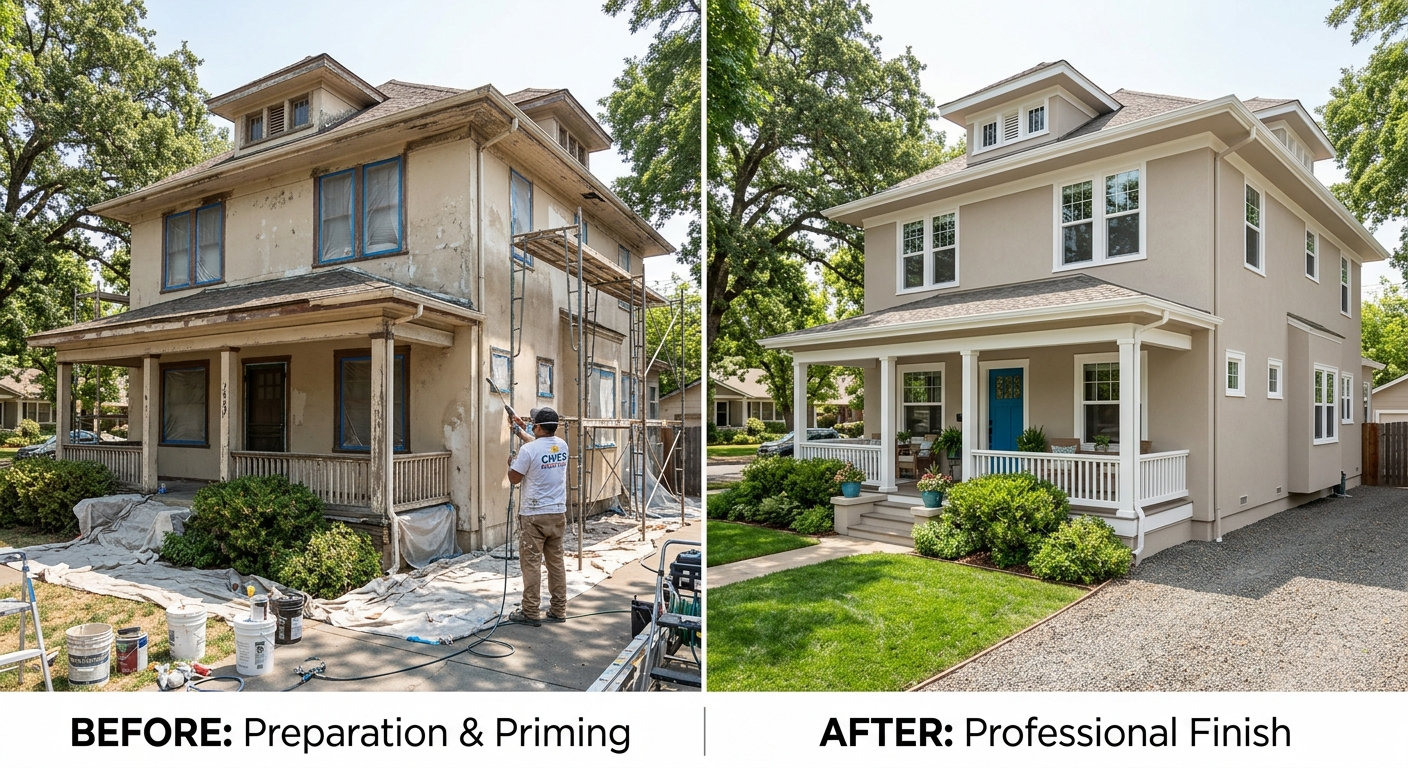
You could buy the most expensive bucket of paint in the world... but if you put it over dirty, chalky, or peeling siding, it will fail in less than a year. The secret to hitting that 10-year lifespan is entirely in the preparation. This is where professional exterior house painters Chico homeowners hire earn their keep.
- Deep Cleaning: We start by pressure washing to remove mildew, dirt, and that chalky binder residue. Paint cannot stick to dust.
- Scraping and Feather Sanding: Loose paint must be removed aggressively. We scrape away the flakes and then machine sand the edges to "feather" them out. This ensures the new paint lays down smoothly and doesn't just peel up the old edge.
- Priming Bare Wood: As we mentioned in our guide on interior vs. exterior chemistry, exterior primers are chemically designed to bite into the wood fibers and provide a uniform surface for the topcoat. Spot priming repairs is mandatory; full priming is often recommended for older, weathered wood.
- Caulking: We fill gaps around trim, windows, and doors with high-grade elastomeric sealant. This keeps water out of the wall cavity.
If a painting contractor offers you a quote that seems too good to be true, ask about their prep process. Often, the "fast and cheap" jobs skip the scraping and priming, which is why those paint jobs peel so quickly.
Factors That Shorten Paint Life (And How To Fix Them)
Sometimes paint fails early not because of the product, but because of the environment. Here are a few things that kill paint faster in Chico:
- Sprinklers hitting the house: This causes hard water stains and constant wet/dry cycles that rot wood in record time. Fix: Adjust your sprinkler heads immediately.
- Vegetation: Bushes rubbing against the paint act like sandpaper in the wind and hold moisture against the wall. Fix: Trim plants at least 12 inches away from the siding.
- Dark Colors: Dark paint absorbs way more heat, causing more expansion/contraction stress. Fix: Consider lighter colors for south-facing walls, or use new "vinyl-safe" paint technologies formulated to reflect heat even in dark shades.
- No Eaves/Overhangs: Walls with no roof overhang get hit by 100% of the sun and rain. Fix: These walls simply need to be painted more often than the rest of the house.
How SGB Custom Painting Can Help
At SGB Custom Painting, we treat every exterior like it is our own home. We know the Chico climate... we know how the sun hits homes in Butte Creek Canyon versus the avenues... and we know exactly which products stand up to the heat. We don't just spray and pray. We spend the time to prep your surfaces correctly so your investment lasts.
We start every project with a thorough inspection. We look for the rot you might miss. We check the moisture content of the wood. And we recommend the right product... whether it's a solid stain for your fence or a high-build acrylic for your stucco.
If you are looking at your home and seeing chalky residue or faded trim, let's take a look. Even if the winter rains have started, we can often perform inspections, minor repairs, or plan your project for the first available weather window in spring. Reach out to SGB Custom Painting today to schedule a free estimate. Let's protect your home for the long haul.
About SGB Custom Painting
SGB Custom Painting is a trusted Chico Painting Contractor known for clean prep, clear communication, and color that holds. For more than twenty five years, our local team has delivered interior, exterior, and cabinet projects for homes and businesses with careful protection, proper priming, and tidy jobsites. We follow EPA lead safe practices on older properties, keep schedules dependable, and give every project the respectful touch the North Valley deserves.
Love Your Space Again, Starting Today!
Locally Owned & Operated • EPA Lead Safe Certified • CSLB Licensed
Call 530-924-4109 or complete the form and expect a friendly call to confirm scope, discuss color options if needed, and deliver a no surprise estimate you can approve with confidence.
Contact Us
Refresh Your Home With Professional Painting
If you are thinking about repainting your interior, freshening up exterior siding, updating tired kitchen cabinets, or giving your business a cleaner look, our team is here to help you plan it right and paint it to last. Reach out to SGB Custom Painting to talk through your project, get honest expert guidance, and take the next step toward a home or workspace you will be proud of every day.
Follow Us
Elevate Your Space with SGB Custom Painting